
Andrew Liddle, Guest Writer
The Trial Of Romeo Oscar - Stephen Joseph Theatre, Scarborough
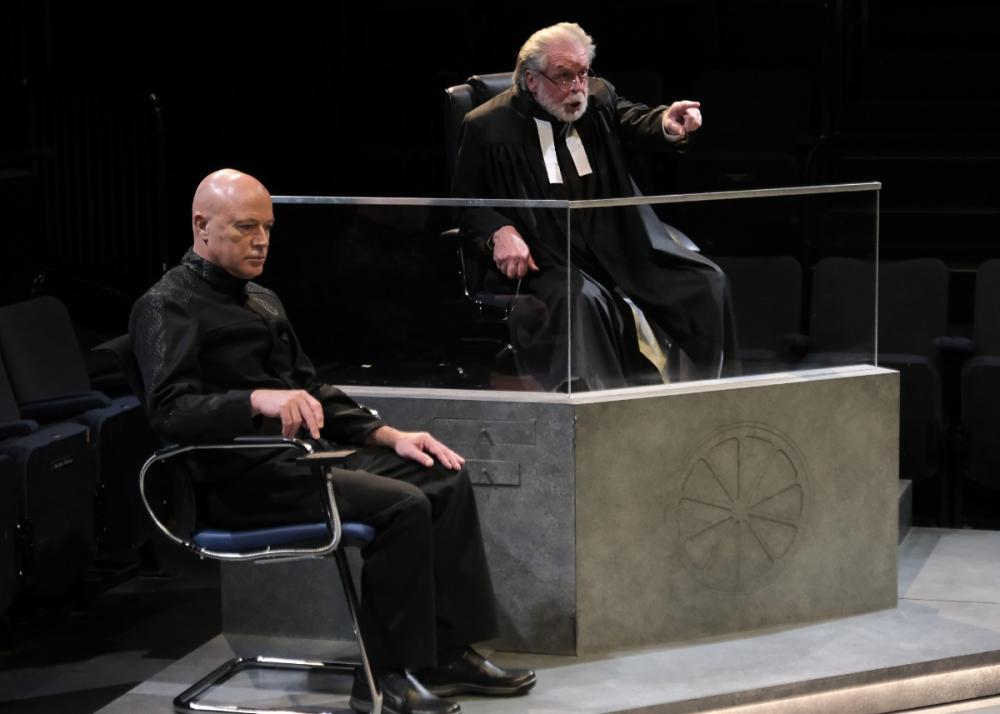
(L-R)Leigh Symonds, Russell Richardson
Photo: ©Tony Bartholomew
The Trial of Romeo Oscar, his 92nd play, receiving its world premiere at the SJT, Scarborough, is less a sudden excursion into the current anxieties surrounding artificial intelligence than a natural continuation of an interest sustained for more than six decades.
Set in 2194 within a subterranean, post-war London, the play depicts a society divided into three distinct castes: natural humans, synthetic Replicants and functional androids. At the heart of the drama sits RSDO 83 - call sign Romeo Oscar - a soldier-android accused of murdering an orphaned human child on Titan, a distant planet.
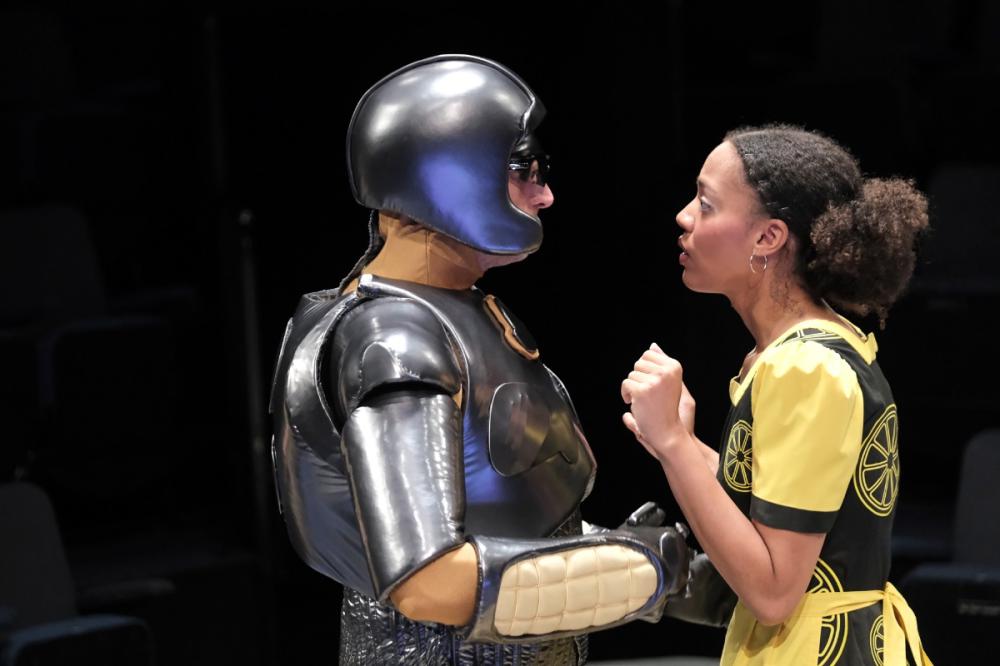
(L-R)Richard Stacey, Olivia Woolhouse
Photo: ©Tony Bartholomew
Under Ayckbourn’s own sure-footed direction, the courtroom procedure swiftly expands into a multi-layered, multi-faceted allegory encompassing corporate hegemony, labour exploitation and class struggle. But there is considerably more going on beneath the surface.
For centuries, human societies have created hierarchies in which one group assumes the right to define the status and purpose of another. Ayckbourn simply moves that familiar conflict into a future where the subordinate beings begin to possess the intelligence, adaptability and capability to demand equality. Suddenly, the murder trial of one android becomes an examination of the entire social order.
Chief Arbiter Jefferies, 120 years old and at times a little world-weary, may occupy the position of ultimate legal impartiality, but there is something definitively human about his capacity to be diverted by sentiment, even as he presides over a precedent-setting case weighing in the balance the hierarchy of the new order and the relative status of the three castes. Russell Richardson makes the part his own.
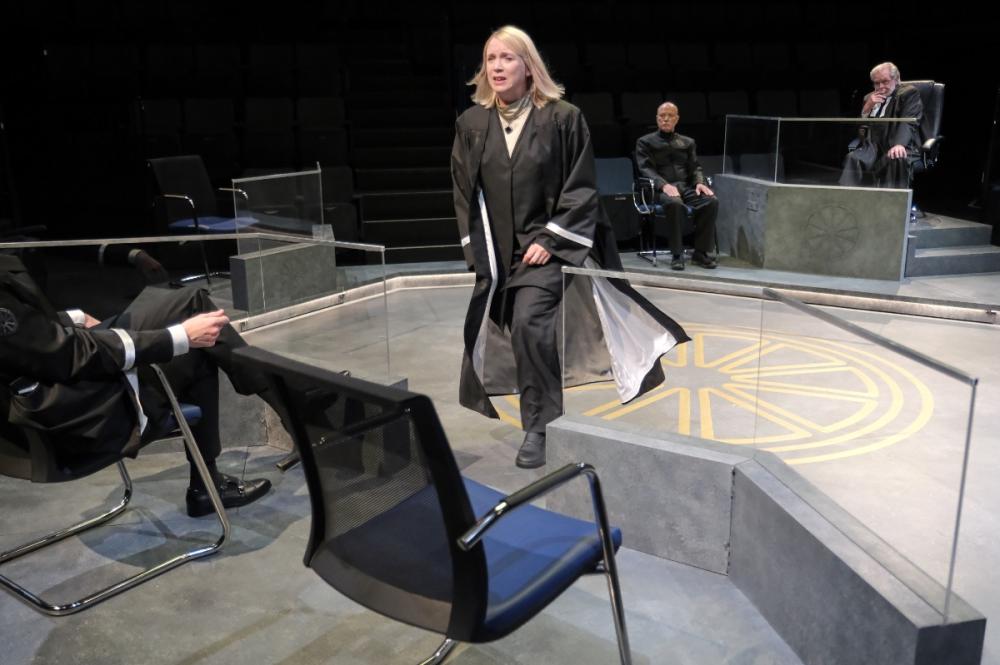
(L-R)Frances Marshall, Leigh Symonds, Russell Richardson
Photo: ©Tony Bartholomew
Leigh Symonds excels as Assistant Arbiter Octavius, the ultra-efficient court functionary whose faintly robotic manner makes the distinction between human and android deliciously ambiguous. Symonds finds comedy in the character’s precision and programmed pedantry without reducing him to a mechanical caricature.
On the other side of the courtroom, Frances Marshall’s Allistra Clay brings earnestness, compassion and fierce determination to the defence. She is genuinely committed to defending her android client and to challenging the assumptions underlying the prosecution case. Opposite her, Hayden Wood’s Ronal Lime-Tyler is slick, confident and considerably more knowing - a prosecutor entirely at home manipulating the machinery of the law.
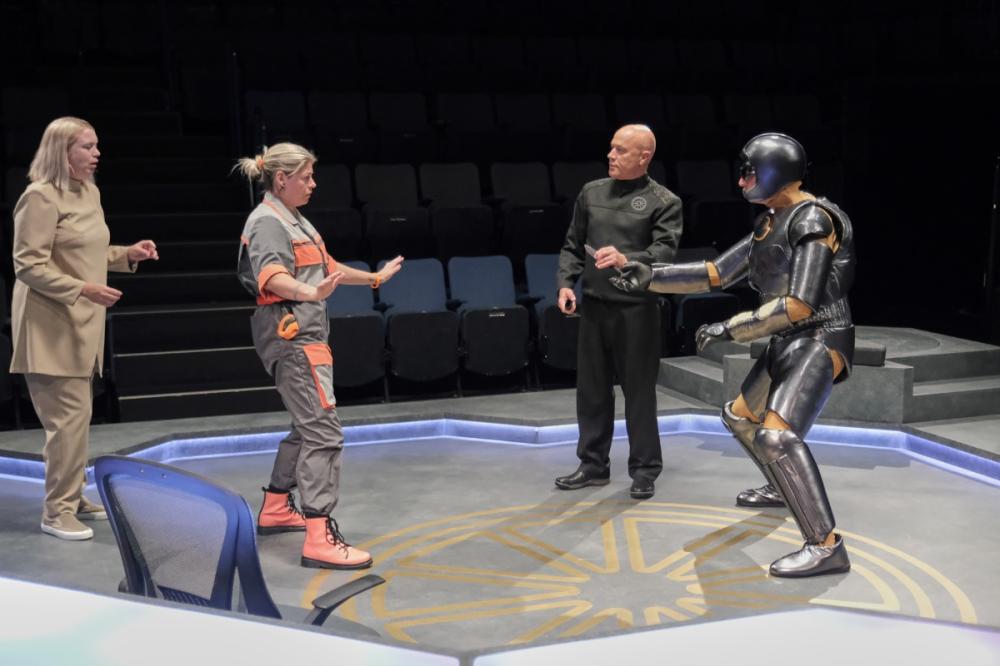
(L-R)Frances Marshall, Elizabeth Boag, Leigh Symonds, Richard Stacey
Photo: ©Tony Bartholomew
What initially appears to be a landmark murder trial blossoms into something much larger. Gradually, it becomes clear that appearance, biology and behaviour can no longer be relied upon as straightforward definitions of individual identity. The androids created by humans to defend them, serve them and do their bidding, enabling their creators to live much longer and even begin to contemplate immortality, are themselves beginning to demand parity. The more menial among them are agitating for better working conditions and less demand upon their batteries. Their growing unrest threatens not only the established social hierarchy but powerful corporate interests, notably the all-powerful Citrus Corporation, represented to all intents and purposes by the prosecuting counsel.
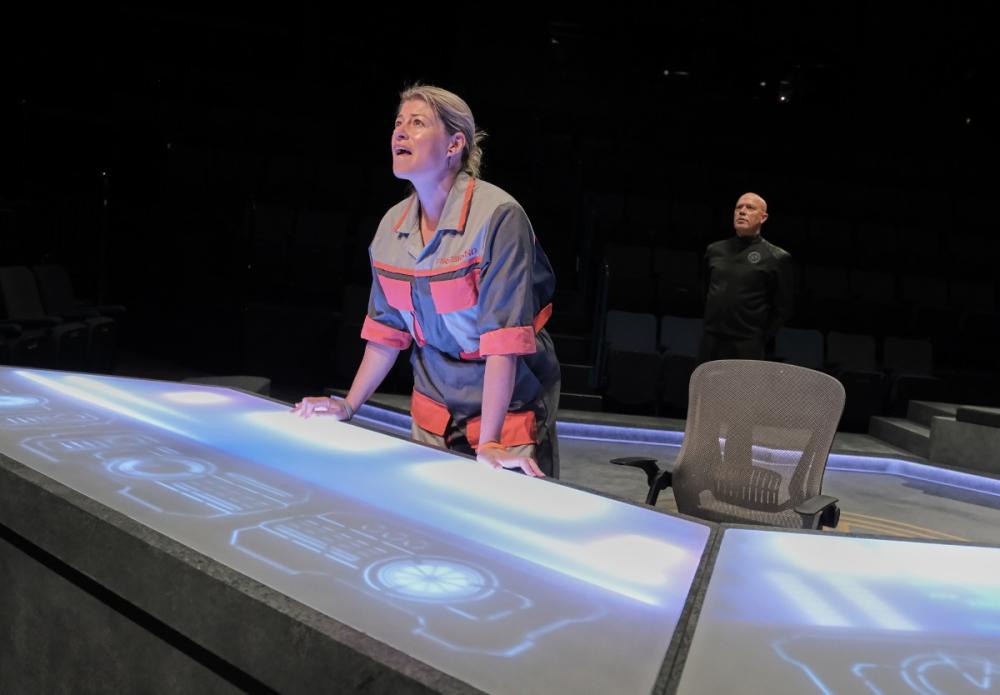
(L-R)Elizabeth Boag, Leigh Symonds
Photo: ©Tony Bartholomew
Richard Stacey’s RSDO 83 - Romeo Oscar - carries the weight and premise of the central issue. Here is a military machine whose history with the orphaned girl raises the play’s most troubling questions about programming, adaptation, responsibility and choice.
The excellent Olivia Woolhouse’s Hermione Quinque, a waitress, provides another intriguing indication of the boundaries between human and android beginning to dissolve. An amateur actress in her spare time, Hermione offers evidence of androids becoming more human, taking on feelings and emotions and embracing art. She immediately warms to playing Juliet to Oscar’s Romeo, a delightful and telling development.
The Trial of Romeo Oscar is a fascinatingly complex, hugely intriguing and insightful allegory of our own times, asking us to imagine what might happen when a created underclass begins to question the terms of its existence. The parallels are never so crudely drawn that the play becomes a political tract. Instead, Ayckbourn, the master, leaves us to make the connections ourselves about who decides what constitutes a person; who has the right to determine another being’s purpose; and, crucially, at what point does obedience become exploitation?
When those created to serve begin demanding the same rights as their creators, what happens to the society that depends upon their subservience? One suspects this will now be mankind’s big story that never goes away, and Ayckbourn’s particular genius may have been to recognise it early enough to subject it to the dramatic crucible while it is still unfolding around us.
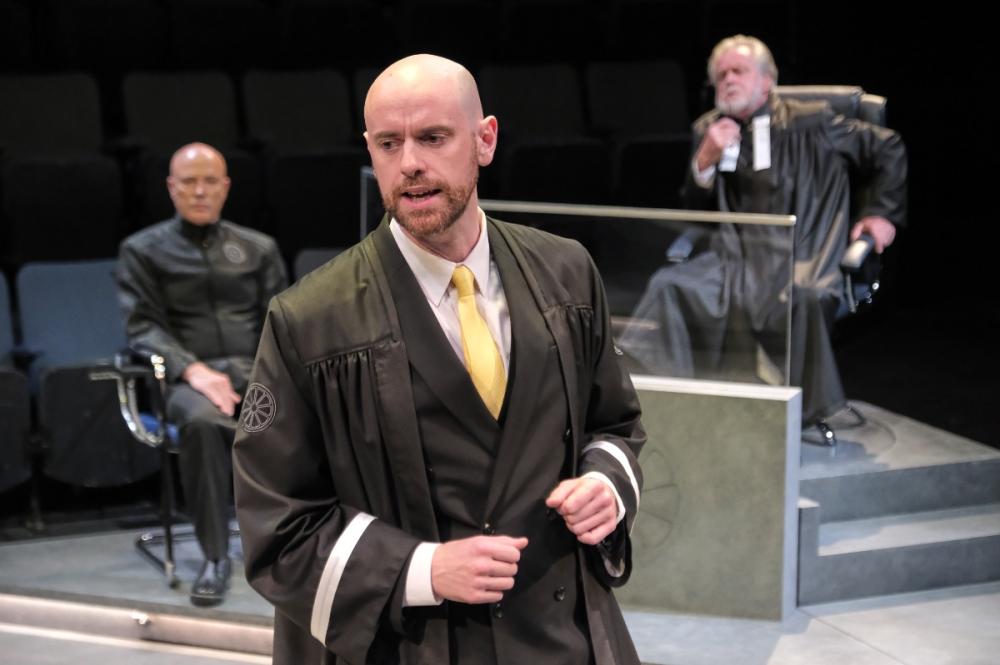
Leigh Symonds, Hayden Wood, Russell Richardson
Photo: ©Tony Bartholomew
There is an intriguing continuity here with Comic Potential. There, Ayckbourn explored artificial life through comedy, asking whether an android could experience love, laughter and the creative impulses we regard as uniquely human. In The Trial of Romeo Oscar, the question has moved beyond whether an artificial being can imitate humanity. It has become a question of rights, status and the consequences for the society that created it.
Kevin Jenkins’s judicious design and Mark ‘Tigger’ Johnson’s atmospheric lighting create a world sufficiently strange to establish the futuristic setting without allowing the technology to overwhelm the actors or the ideas. The production remains rooted in the courtroom, allowing the audience to concentrate on the shifting relationships and arguments.
There is a huge amount going on here. At times, the density of ideas threatens to overtake the narrative momentum, but that is also part of the play’s fascination. It refuses to be reduced to a single argument about AI. It is at once a courtroom drama, science-fiction speculation, social allegory and philosophical inquiry into identity, equality and consciousness.
And perhaps that is where the trial ultimately leads us. Romeo Oscar was created with a purpose - to kill. Yet in the course of fulfilling that purpose, he appears to have acquired something his creators never intended: the capacity to care. The question is therefore not simply about Romeo Oscar’s acquired humanity. It is whether humanity will recognise, shall we say, personhood when it encounters it as a rival in a form of its own making.
It is these profoundly unsettling questions that makes The Trial of Romeo Oscar such an exhilarating piece of theatre. It looks towards a future of artificial intelligence, synthetic life and shifting social hierarchies while keeping its focus firmly on the oldest existential questions of all that philosophers have pondered for millennia.
For a playwright who has been exploring the possibilities of speculative drama for more than sixty years, Ayckbourn has once again proved remarkably ahead of his time. The Trial of Romeo Oscar is not simply an intelligent and ambitious new play but a provocative, timely and deeply engaging piece of theatre that is destined to run and run.
It’s got the West End and Broadway written all over it.