

Andrew Palmer, Group Editor
Sacred Ground: Andrew Harrison's Transcendent Portrayal of Henri Nouwen
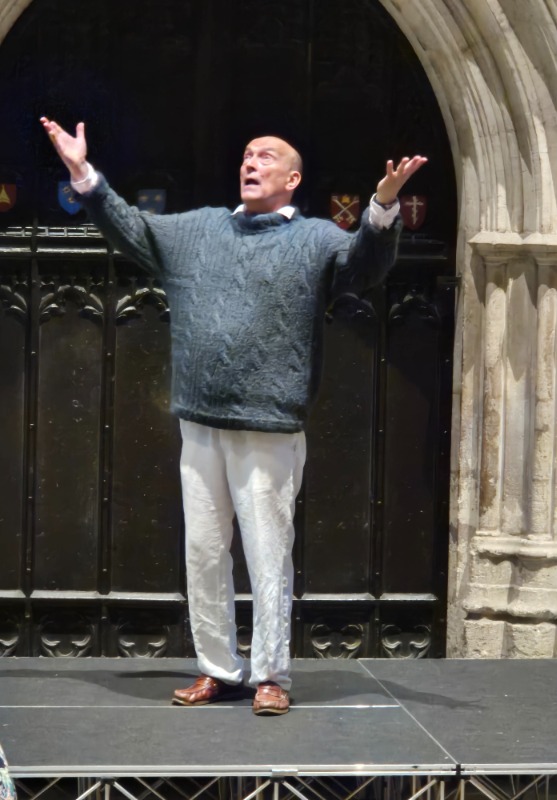
Andrew Harrison
Photo: Andrew Palmer
Harrison's portrayal of Henri Nouwen—the Dutch Catholic priest and psychologist who forsook academic acclaim to serve those with intellectual disabilities—possessed an almost sacramental quality. From his first unassuming entrance beneath the cathedral's organ case, accompanied by Mozart's Requiem, Harrison established an atmosphere of contemplative intimacy that held the audience in rapt attention throughout the 75-minute monologue.
The script, celebrating Nouwen's journey of his life (1932 to 1996), charts a life that challenged both ecclesiastical and secular assumptions about worth and purpose. Watts has crafted a narrative of remarkable sophistication, weaving together the profound and the quotidian with an intelligence that respects both his subject and his audience. The humour that punctuates the text never trivialises Nouwen's struggles but illuminates them, revealing humanity beneath sanctity.
Harrison's vocal dexterity bordered on the virtuosic. His seamless transitions between accents—American, Russian, and Dutch—each calibrated to distinct tonal registers, created a populated world with a single performer. These weren't mere impressions but fully realised characterisations that gave voice to the community and shaped Nouwen's understanding of divine love. His physical choreography, executed with balletic precision, transformed the cathedral's crossing into multiple locations without recourse to elaborate staging.
What elevates this performance beyond technical mastery is Harrison's ability to communicate the ineffable. His embodiment of Nouwen's spiritual crisis—the wrestling with sexuality, family expectations, and ecclesiastical authority—conveyed with sublime authenticity the terrible beauty of a soul in search of its true purpose. In Harrison's hands, Nouwen's decision to work with the intellectually disabled in the L'Arche community becomes not a self-abnegation but a spiritual awakening.
The cathedral setting proved more than atmospheric; it became participatory. The building seemed to respond to Harrison's invocation of Nouwen's mystical experiences, while the ancient stones bore witness to this contemporary exploration of timeless themes. The acoustics, rather than overwhelming the intimate nature of the piece, amplified its emotional reverberations.
This is performance as pastoral care, and theatre as spiritual discipline. Harrison has accomplished a feat akin to artistic transcendence—a theatrical masterpiece that delves into the most profound enquiries of human purpose. In an age of spiritual hunger, The Beloved Son offers not answers but the more valuable gift of meaningful questioning.
The Ripon Theatre Festival could not have chosen a more auspicious beginning. This is essential theatre: profound, moving, and ultimately transformative.
More articles in this series...
What Ripon Theatre Festival Gets Right: A Masterclass In Arts ProgrammingA Dream Come True: The Three Inch Fools Cast Their Spell In RiponShaken, Stirred, And Absolutely Smashing!Titanic Tale Leaves Audiences BreathlessTheatre Takes Centre Stage: Katie Scott on Ripon's Bold Cultural Revolution