

Andrew Palmer, Group Editor
Jazz: There's a Yearnin'
There’s a Yearnin Music for Winds and Voice
Cruxifiction (not a word) (Lederer); Dolphy Wind Sextet; Coleman Forms and Sounds 1,2,3;
Nelson/lyric LaRose Images; Lem and Aide;
Nocturne; There’s a Yearnin’; Three Seconds
Little (i) Music, May 2026
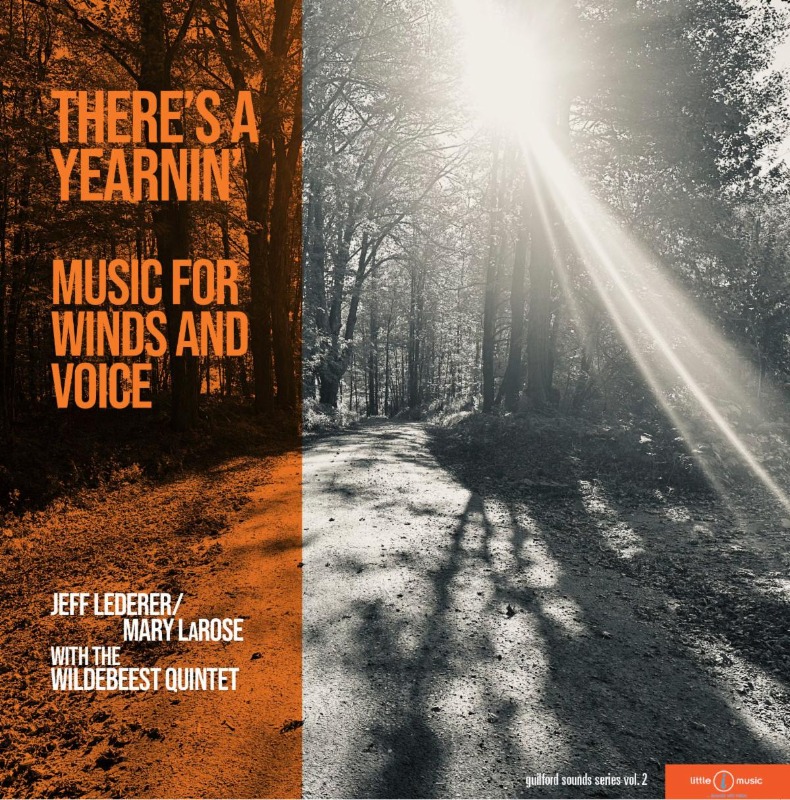
Saxophonist and composer Jeff Lederer has built a career on bold reimaginings, but There's a Yearnin' may be his most ambitious yet. The disc gathers significant underheard works — the first recording of a woodwind sextet by Eric Dolphy; a new realisation of Ornette Coleman's rarely performed Forms and Sounds; and freshly arranged Oliver Nelson pieces for winds and voice — alongside a rescored Lederer original.
The Dolphy manuscript, preserved in the Library of Congress and never performed in his lifetime, lit the spark for the entire project. "There's a little bit of a sense of a dream unfulfilled with Dolphy and his notated music," Lederer says. Coleman's quintet, commissioned in the late 1960s, has been seldom revived; Nelson's concert ambitions were too often crowded out by commercial scoring. Restoring all three to circulation feels overdue.
Vocalist Mary LaRose, Lederer's long-standing collaborator, is the disc's beating heart. Her voice is enticing, full of passion and hauntingly beautiful, moving between sung lines, spoken word and scatting vocalese with extraordinary command. The Brooklyn-based Wildebeest Wind Quintet — Michel Gentile (flute), Katie Scheele (oboe), Mike McGuiness (clarinet), Sara Schoenbeck (bassoon) and Nathan Koci (French horn) — brings the precision these scores demand and the improvisatory instinct their creators valued. The combination of instruments fits like a glove; flute writing is particularly atmospheric.
Lederer's own contribution, Cruxifiction, dates from his Oberlin studies in 1982 and is newly arranged for winds and immersive electronics. Inspired by Marian Anderson's landmark performance of "They Crucified My Lord", it confronts silenced dissent – the crux as the central issue, stripped of religious framing.
Recorded at Guilford Sound in Vermont, where woodwinds resonate amid actual woodlands, the disc carries a cohesive, mood-driven sound. Lederer's saxophone playing moves fluidly between restraint and expression, conversational in its phrasing, never overplayed but always present with purpose. Dynamics and phrasing come together brilliantly.
There are wonderful resonant moments here, and a clear artistic vision shines through. This is jazz that communicates superbly, vibrant and fresh – and quietly insistent that these scores belong not in archives but in the living repertoire.