

Andrew Liddle, Guest Writer
From Alpine Roots To Global Stages: How Oesch’s Die Dritten Keep Tradition Alive
.jpg)
Melanie Oesch is stunning in red
Their name, meaning “the third generation,” is more than a clever title, but a statement of lineage. The group’s story spans three generations of musicians who have helped shape Swiss folk music while remaining rooted in the landscape and culture from which it emerged. What began as a family tradition has evolved into an international success story that has seen the group perform more than 2,000 concerts in 16 countries, earn multiple gold and platinum records, and introduce audiences around the world to the distinctive sound of Swiss yodelling.
Yet their origins are remarkably modest. Music was never something separate from daily life in the Oesch household. It was simply part of the family fabric.
Melanie Oesch, the group’s charismatic lead singer and quite magnificent yodeller, grew up surrounded by rehearsals, impromptu performances and visiting musicians. Her grandfather had founded Trio Oesch after deciding there was too much imported popular music and not enough Swiss music being written and performed. Although he was not regarded as one of the great virtuosos of the genre, his gift for simple, memorable melodies earned him national television appearances and international engagements. Melanie’s father, Hansueli Oesch, carried the tradition forward, first as a singer and yodeller and later as an accomplished Schwyzerörgeli player with both Trio Oesch and the highly regarded Schwyzerörgeli Quartet Stockhorn.
“We grew up in a very musical household,” Melanie recalls. “My grandfather and my father played in various bands and often rehearsed with them at our house. When we had guests over, we’d often just start making music spontaneously. That was just normal.”
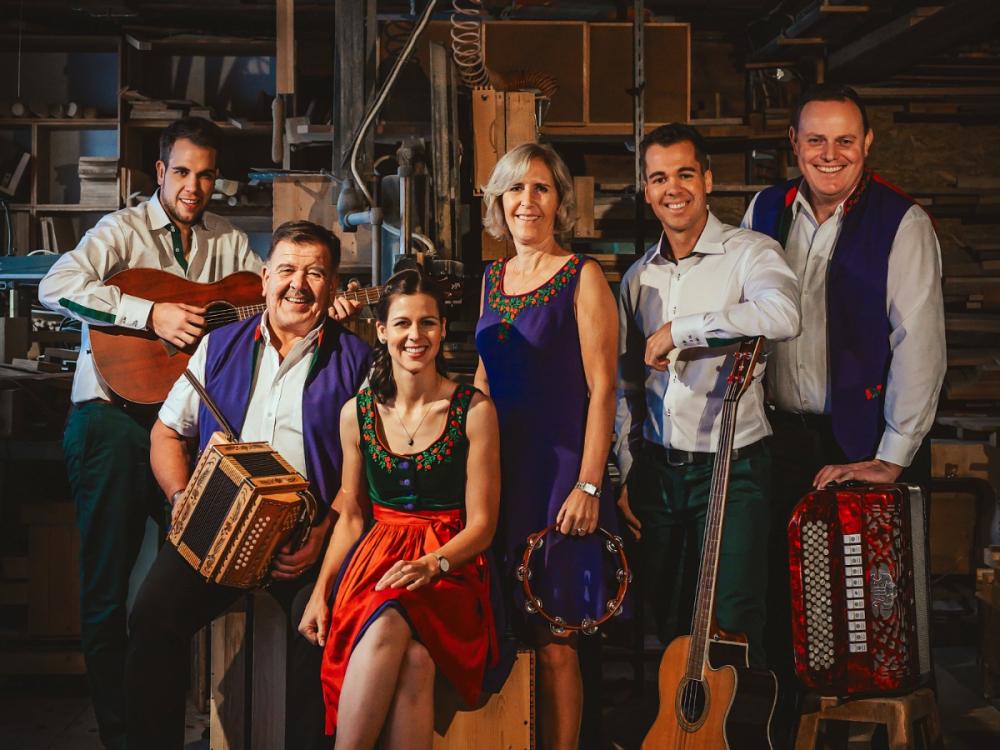
Oesch’s die Dritten at home
Unlike many classical vocal traditions, there was no formal programme of study. Her father taught her the basics, but much of what followed came through listening, curiosity and experimentation.
“I learned to yodel mainly by listening and experimenting,” she says. “I realised very quickly that I was particularly good at the rhythmic yodel parts and that the tongue-click technique is my favourite.”
That tongue-click yodel has since become her trademark. It is a dazzlingly rhythmic and athletic vocal technique that combines precision with exuberance and has helped make her one of the most recognisable voices in contemporary Alpine music.
Although deeply-rooted in folk traditions, Melanie's musical tastes extend far beyond them. She speaks enthusiastically about blues, rock, reggae, Irish folk, singer-songwriters and world music, influences that help explain why Oesch’s die Dritten have never fitted comfortably into conventional categories. Their music draws upon tradition without being confined by it.
The beginnings of the group itself were similarly organic. As children, Melanie and her brothers often accompanied family performances, occasionally presenting a few songs of their own before returning to the audience. The turning point came in 1997 when the young musicians appeared on local television under the name Oesch’s die Dritten for the first time. “That was our official debut,” Melanie adds.
At first the group played local festivals, village celebrations and regional events. Few imagined that this family ensemble from a small Bernese village would eventually become one of the biggest names in contemporary Volksmusik. Melanie herself certainly did not. “I never really dreamed of a career in music,” she admits. “I loved singing and yodelling, but I couldn’t imagine there was a way to do it professionally.”
There was another concern too. “I was worried that the music - and yodelling in particular - would lose its personal meaning if I did it every day.”
Instead, however, the opposite happened. Everything changed in 2007 when the group won a major televised folk music competition. Overnight, they found themselves in front of audiences across Switzerland, Germany and Austria. Their album Jodel-Zauber became a major success, remaining in the Swiss charts for well over a year and establishing Oesch’s die Dritten as a fresh force within Alpine music.
“Winning that competition turned everything upside down,” Melanie says. “Music has been my profession ever since.” Success arrived quickly but proved enduring. Albums continued to chart, audiences grew steadily and invitations arrived from increasingly prestigious venues. Along the way the group collected numerous honours, including multiple Prix Walo awards - often described as Switzerland’s equivalent of the Oscars - and a succession of gold, platinum and double-platinum records.
Some memories stand out vividly. Melanie recalls the sold-out finale of a tour at Montreux’s Auditorium Stravinski, a stage that has welcomed artists such as Elton John and Joan Baez. Yet she is equally fond of smaller venues where the connection between performers and audience can feel more immediate.
“I also like to look back fondly on many small concert venues,” she says, “because the music and the act of making music together there perhaps hold even greater significance than on the big stages.”
Part of the group’s appeal lies in its unusual musical chemistry. At its heart remains the family unit: Hansueli’s Schwyzerörgeli, his bravura talent on the button-accordion, provides the traditional backbone; Annemarie Oesch contributes vocals, keyboards and artistic direction; brothers Mike and Kevin bring bass and guitar; and long-time collaborator, Urs Meier, adds further accordion melody and rhythm.
“We rehearse together regularly,” Melanie explains. “But because we don’t write out our songs in musical notation, there’s always plenty of room for improvisation during live performances- and that’s just the way we like it.” That spontaneity extends to her yodelling. “In my case, improvisation is a very common part of it,” she says.
Perhaps the most fascinating aspect of Melanie’s career is her relationship with tradition itself. While she sees herself firmly as part of Switzerland’s yodelling community, she has never been entirely comfortable with rigid definitions of what yodelling should be.
“The guidelines of the Swiss Yodeling Association always felt a bit too restrictive to me,” she says. “I’ve been forging my own path since I was a child.” Over time her distinctive style became central to the group’s identity and success. “Today my style of yodelling is certainly part of my identity as an artist and also my trademark.”
Her philosophy is not one of rebellion but of connection. “I see myself very much as a bridge-builder,” she says. “I love it when other people are introduced to yodelling through Oesch’s die Dritten and then immerse themselves in this world and eventually get to hear the very traditional repertoire as well.”
That sentiment perhaps explains the group's enduring popularity better than anything else. Oesch’s die Dritten have never treated tradition as something to be preserved behind glass. Instead, they have allowed it to breathe, evolve and reach new audiences.
This openness proved especially valuable during the COVID-19 pandemic. Like countless performers, the group suddenly found themselves unable to tour. Rather than retreat, they turned to livestreaming. “The live streams back then were an experiment,” Melanie recalls. “It was a great experience.”

For many fans confined to their homes, those performances offered a welcome sense of connection and optimism. Indeed, positivity may be the defining quality of Oesch’s die Dritten.
Critics once struggled to categorise their music, searching for labels that never quite fit. “People were looking for a musical label that didn’t really exist,” Melanie says. “Eventually we realised we didn’t need that label. Our music thrives on emotion, positive energy, passion and the joy of playing.”
Maintaining such an energetic performance schedule naturally requires discipline, especially for a vocalist whose technique places unusual demands on the voice. “Yodelling puts a different strain on the vocal cords than singing,” she explains. “Over all these years and with so many concerts, my voice has also gotten older - or more mature. Nowadays I have to practise a lot more and work on my breathing technique.”
Looking ahead, there is little sign of the group slowing down. A new album is expected in early 2027, followed by the major MERCI tour celebrating thirty years on stage. More dates are already being planned through 2028.
And what of Britain, where a growing number of listeners have discovered the group through recordings and online performances? “A stop in Britain would be really great,” Melanie says, with a twinkle, not giving anything away.
For a family ensemble that began by entertaining local audiences in a small Bernese village, the possibility seems entirely fitting. Oesch’s die Dritten have spent nearly thirty years demonstrating that folk traditions remain strongest not when they are preserved unchanged, but when they are shared, reinterpreted and allowed to grow. Through talent, creativity and an infectious enthusiasm for music-making, they have carried the sound of the Alps far beyond its mountain birthplace.
In doing so, they have become more than performers. They are custodians of a living tradition, ensuring that one of Europe’s most distinctive musical voices continues to echo across borders, generations and cultures. They are brilliant exponents of a traditional form which is now becoming synonymous with them. Above all, Melanie has the sort of talent that comes round very, very rarely. She is the Swiss Superstar!