

Andrew Palmer, Group Editor
Classical Music: Vito Palumbo Woven Lights
Woven Lights
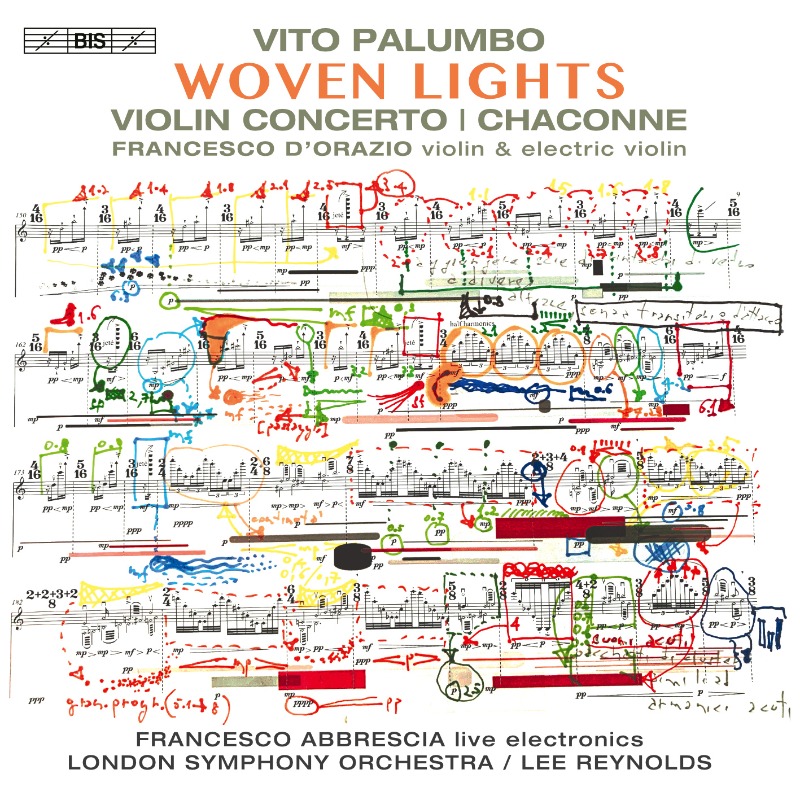
Vito Palumbo: Woven Lights: Violin Concerto, Chaconne
Francesco D'Orazio violin
London Symphony Orchestra - Lee Reynolds
Francesco Abbrescia Live Electronics
BIS-2625 CD
Instrumentarium
Violin Concerto Violin: Giuseppe Guarneri, Cremona 1711; Bow: Nicolas Voirin, Paris 1880
Chaconne
Electric 5-string violin from Alter Ego (2007)
Woven Lights
Electronics: Csound, Cycling’74 MaxMSP
https://bis.se/
Vito Palumbo: Woven Lights: Violin Concerto, Chaconne
Francesco D'Orazio violin
London Symphony Orchestra - Lee Reynolds
Francesco Abbrescia Live Electronics
BIS-2625 CD
Instrumentarium
Violin Concerto Violin: Giuseppe Guarneri, Cremona 1711; Bow: Nicolas Voirin, Paris 1880
Chaconne
Electric 5-string violin from Alter Ego (2007)
Woven Lights
Electronics: Csound, Cycling’74 MaxMSP
https://bis.se/
Gianni Morelenbaum Gualberto, in the notes to this album, writes that some years ago a biting joke, but not without truth, circulated in Europe about Italian politics: ‘Italian prime ministers are like buses: just wait a little and another one arrives.’ The same cannot be said, however, of Italian composers active during this first part of the 21st century.
Among the reasons Gualberto cites for this is an obsolete and provincial concert system in which both audiences and musicians cleave to a repertoire which at best includes works from the early 20th century. How true that is, across the board.
For many, who cannot move away from what is traditionally called ‘classical music’ - a label that is wrongly attributed to the genre since, historically, the classical music period was 1750 to 1830 - this concept will be alien, will confuse, may be complicated to grasp, may even grate on musical tastes.
If, as I would encourage, you give it a go, 41 year-old Italian composer Vito Palumbo, who began his career with postmodern experiments, later focusing on exploring the possibilities of the voice in different forms of music theatre, will transport you into the realm of electronics, of musical sounds not heard before and challenge a rethinking of what music means to us.
It is an audacious composition and recording on the BIS label and a project that certainly does not phase the London Symphony Orchestra under the direction of Lee Reynolds, an award-winning conductor with a reputation for bringing intensity and exceptional detail to his performances.
In the one movement Violin Concerto many influences may be heard, especially from the Second Viennese School. The effective use of a small melodic cell presented repeatedly is highly effective, as Palumbo notes: ‘The listener can hear this in the concerto’s first minutes, right before an accelerando and a gradual crescendo that lead to an orchestral explosion, a climax that precedes the moment in which the violin raises its energetic and impetuous voice, as if it were trying to stand up to the full power of the orchestra.’
Palumbo has an understanding of the violin that fits with the sounds he creates and throughout this demanding piece Francesco D’Orazio rises to the challenge.
Palumbo’s compositions on this album are like synapses that bring a series of different voices together to form a junction through which electronic musical colour that seems disparate, comes together in a celestial harmony.
Palumbo’s ingenuity lies in how he manages to let time and space speak through what Gualberto describes as ‘unusual combinations of timbre’. Flashes of sound energetically pull the listener into an unfamiliar soundscape from which it is hard to escape. The last five minutes are incredibly intense as D’Orazio performs with flair.
The Chaconnes: Woven Lights and The Glows in the Dark are two equally interesting works where the listener’s predetermined concepts are challenged by using abstract electronic sounds, which in the case of The Glows in the Dark is in the form of thirty overlapping parts, pre-recorded by the same soloist and with the same instrument.
It is a fascinating album that will undoubtedly disrupt the way we hear the abstraction from a musical context which for many has been a staple diet. It will make you sit up and question, but in a good way.