

Andrew Palmer, Group Editor
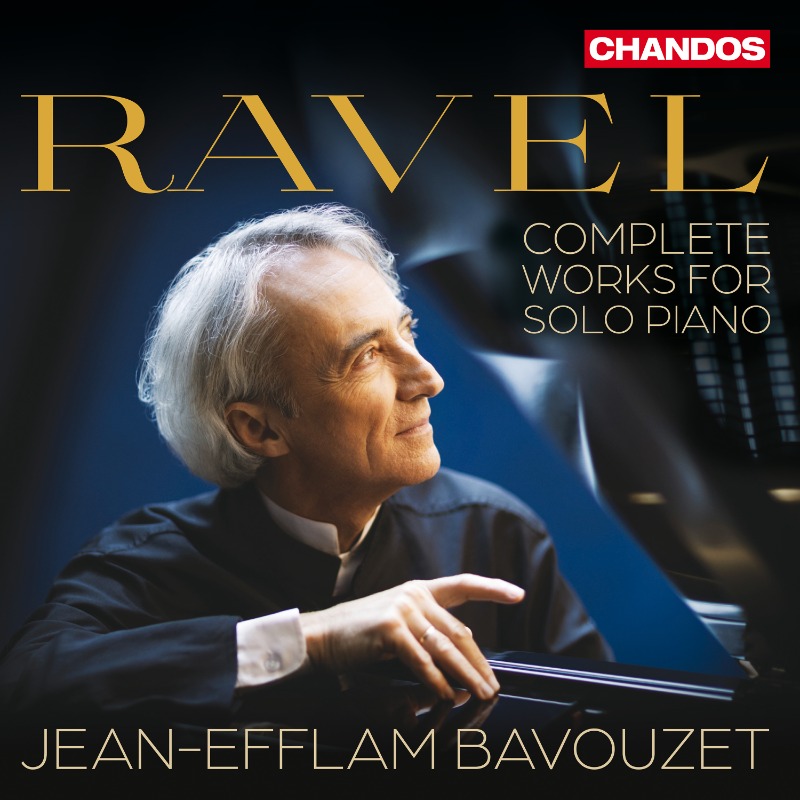
Classical Music: Ravel: Complete Works for Solo Piano
Sérénade Grotesque, M5; Jeux D'eau, M30; Pavane Pour Une Infante Défunte, M19; Sonataine M40; Menuet Antique, M7; Menuet, M42; Menuet Sur Le Nom D'Haydn, M58; Noctuelles; Oiseaux Tristes; Une Barque Sur L'océan; Alborada Del Gracioso; La Vallée Des Cloches; Gaspard de la nuit M55; AA la manière de ...Borodine M63a; A La Manière De...Emmanuel Chabrier, M63b; Le Tombeau de Couperin; 12 Prélude, M65; Valses nobles et sentimentales M61; La Valse, M72b.
Jean-Efflam Bavouzet piano
Chandos CHAN 20287(2)
Chandos.net
Though extraordinarily self-critical and methodical in his composition process, Ravel's relatively small output has endured remarkably well. Nearly his entire body of work remains in the standard repertoire, regularly performed and recorded worldwide.
The piano was Ravel's first instrument, and, although not a virtuoso himself, he composed some of the most technically demanding pieces in the piano repertoire. This reflected his profound understanding of the instrument and precisely what sounds and effects he wanted to achieve. Many of his piano works were later orchestrated by Ravel himself, presenting a unique challenge to performers: once familiar with these orchestrations, one's interpretation of the original piano versions is inevitably influenced—a phenomenon equally true for listeners.
As Jean-Efflam Bavouzet notes, 'I subscribe completely to Ravel's idea that a composer does not have to be profound in order to write good music. And furthermore, owing no doubt to his modest character, Ravel rarely addresses us in the first person. He does not confide in us intimately except on the rarest occasions. At these exceptional moments, our admiration for this musical giant, his intelligence and elegant style of writing, and his perfect proportions, erupts into a wave of emotion that is difficult to contain.'
This captivating double CD from Chandos stands out amid the cornucopia of new releases celebrating the 150th anniversary of Ravel's birth. Bavouzet sets himself apart with the exceptional clarity of his playing—refreshing tempi, lovely tone on his Yamaha model CFX nine-foot concert grand, and an approach that feels both straightforward and bright.
The Sonatine is captured with elegance and nuanced detail, while the simplicity of the Pavane pour une infante défunte is wonderfully executed, its beauty capturing the soul as Bavouzet moves the piece forward with ease. Similarly impressive is his rendering of the miniature Menuet sur le nom d'Haydn. As with all his Chandos recordings, there is much to enjoy and discover in Bavouzet's interpretations.
The 1904 Menuet in C sharp minor, only published recently, is, according to Hugh Macdonald, "in the more modest style, probably a fragment of something larger which remained unrealised." Le Tombeau de Couperin shines brilliantly, as does the final piece on the disc, La Valse.
Regarding La Valse, Bavouzet writes, "I have based myself on the version for orchestra which, apart from the addition of supplementary voices, departs a little from the version for piano, notably at the very end, in the number of swirling, intensifying bars before the fatal quadruplet." The piece shimmers and bubbles along under Bavouzet's hands, with the climax dazzlingly displaying the character of the piece with amazing precision.
What's not to enjoy? This collection offers a masterful tribute to Ravel's piano genius, delivered with both technical excellence and emotional understanding.