

Andrew Palmer, Group Editor
Classical Music: Mozart The Piano Quartets
Mozart The Piano Quartets
Piano Quartet No 1 KV 478; Piano Quartet No 2 KV 493
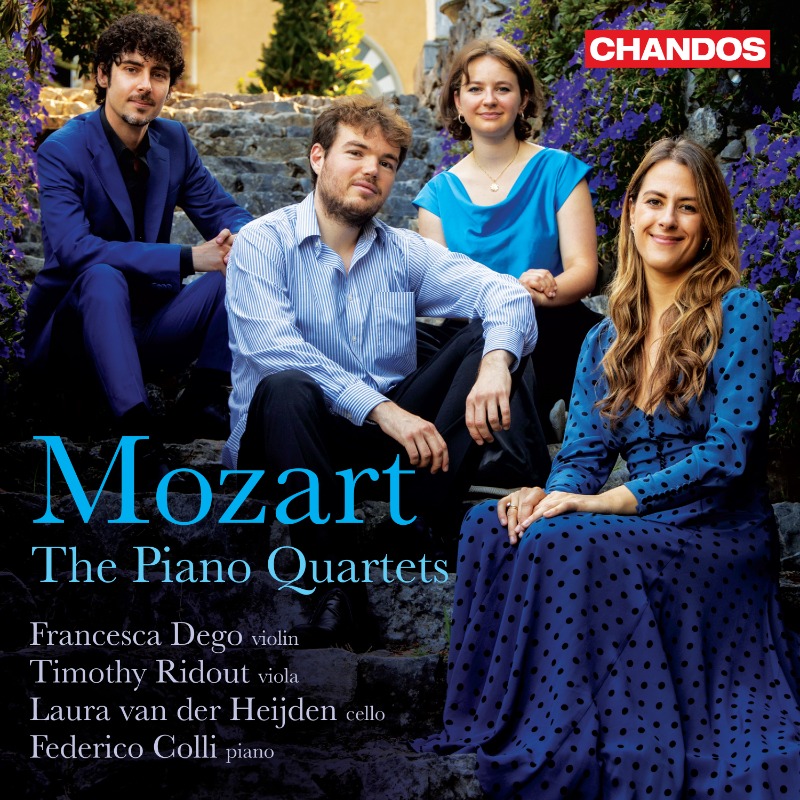
Francesca Dego (violin), Timothy Ridout (violist), Laura van der Heijden (cellist), and Federico Colli (pianist).
Chandos CHAN 20179
https://www.chandos.net/home
Piano Quartet No 1 KV 478; Piano Quartet No 2 KV 493
Francesca Dego (violin), Timothy Ridout (violist), Laura van der Heijden (cellist), and Federico Colli (pianist).
Chandos CHAN 20179
https://www.chandos.net/home
The first quartet is written in the key of G minor, rarely used by Mozart, and the overall mood is quite dark, almost disturbing. The second quartet, in E flat major, is, by contrast, much sunnier in atmosphere.
Colli, whose understanding of Mozart is magically conveyed in his first volume of Mozart’s piano works for Chandos, (Classical-Music-Review-Federico-Colli-Plays-Mozart-Vol-1) glistens with equally insightful interpretations on this album. His delicate playing on a Steinway is full of elegance and lovely phrasing, and he plays with an inspirited, spry vigour.
Joined by his three friends, they are all perfectly balanced, and the performances show the strong camaraderie between the musicians. Each contributes polished articulation without dominating, and together they capture the character of the pieces with assured playing.
Ridout has a wonderful warmth and, along with van de Heijden and Dego, interjects with a vivid intensity and, when needed, offers a light, deft lightness of touch, adding a different dimension.
Their detailed interpretations present a nicely paced, expressive, and sophisticated performance with wonderful tone and superb passagework.