

Andrew Palmer, Group Editor
Classical Music: Holst The Planets
Deborah Cheetham Fraillon Earth (2024 )
Deborah Cheetham Fraillon (soprano)
Women’s Voices of the Melbourne Symphony Orchestra, Warren Trevelyan-Jones chorus director
Melbourne Symphony Orchestra Conductor: Jaime Martin
Recorded 2024, Hamer Hall, Melbourne
Melbourne Symphony Orchestra MSO0003
MSO Available through streaming platforms
The enduring popularity of Holst's 1918 masterpiece—a mainstay of Classic FM's Hall of Fame—speaks to something deeper than mere orchestral spectacle. This isn't really about our solar system at all, but rather the astrological personalities Holst mapped onto his planetary movements, requiring the full palette of a large orchestra to paint these cosmic character studies.
Martin takes Mars at a measured pace that, while lacking the white-hot intensity of some interpretations, reveals extraordinary textural detail in Holst's martial machinery. Venus flows naturally from this warfare, with high and middle strings conjuring that ethereal, otherworldly calm that only follows conflict. Mercury's shifting metres are handled with nimble precision, whilst Jupiter's irrepressible big tune—that melodic asteroid belt of British popular culture—receives a judicious reading that balances grandeur with genuine jollity.
Saturn, reputedly Holst's favourite movement, unfolds with appropriate gravitas as time itself seems slow, marked by harps and low flutes. Here, one wishes for sharper dynamic contrasts to emphasise the movement's inexorable march. Uranus conjures its magical transformations with theatrical flair, the organ adding satisfying heft to the movement's climactic passages, while Neptune dissolves into its famously atmospheric conclusion with harps, celestas, and the ethereal women's chorus, creating that sense of infinite space.
The disc's most intriguing addition is Deborah Cheetham Fraillon's Earth, commissioned to complete Holst's planetary roster. "The Earth is set apart from its neighbours in this solar system by our humanity," notes the composer, and her decision to incorporate the human voice as our defining characteristic proves inspired. The atmospheric opening crescendo leads to a brief but cinematically powerful movement, with Cheetham Fraillon's own soprano delivering her text with compelling authority. It's a work that sits comfortably alongside Holst's original conception while asserting its own distinct voice.
The Melbourne Symphony Orchestra delivers throughout with the confidence of musicians who clearly relish this repertoire. The recording engineers have captured both the orchestra's dynamic range and the specific timbral qualities that make each movement distinctive, particularly in the more rhythmically complex passages where ensemble precision matters most.
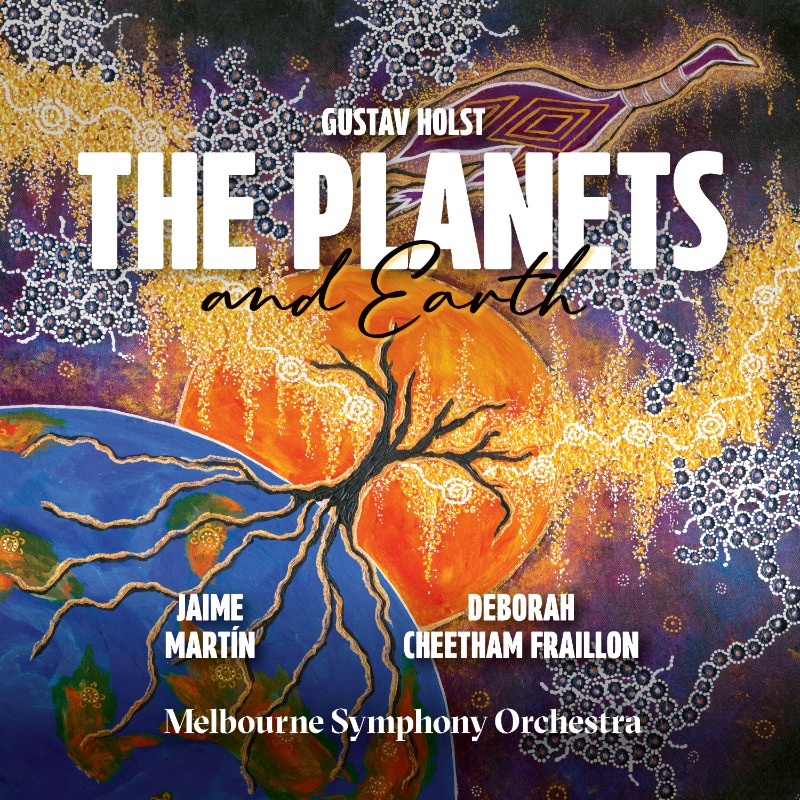
Wurundjeri/Yorta Yorta artist Simone Thomson's cover artwork, depicting earth, stars, and natural elements, provides an appropriately grounded visual complement to these celestial wanderings. While this recording may not revolutionise our understanding of Holst's achievement, it offers enough interpretative freshness to justify its place in an admittedly crowded galaxy of planet recordings.