

Andrew Palmer, Group Editor
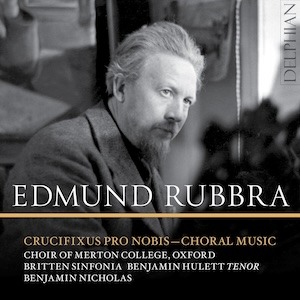
Classical Music: Edmund Rubbra Crucifixus Pro Nobis: Choral Music
Cantata di Camera; The Revival, Op. 58; Five Motets, Op. 37: I. Eternitie; III. A Hymn to God the Father; Prelude and Fugue on a Theme by Cyril Scott, Op. 69; The Virgin’s Cradle Hymn, Op. 3; Missa in Honorem Sancti Dominici, Op. 66; Meditaion for Organ, Op. 79; Symphonic Prelude, Op. 164a ( arr. by Michael Dawney & Robert Matthew-Walker);
Evening Service in A flat, Op. 65
Choir of Merton College, Oxford | Britten Sinfonia
Benjamin Hulett tenor
Conductor: Benjamin Nicholas
Thomas Hancox flute; Marcus Barcham Stevens violin;
Ben Chappell cello; Sally Pryce harp; François Cloete, Owen Chan organ
Delphian DCD34332 2
https://www.delphianrecords.com/
His music on this disc is like a wunderkammer — compositions of rich modal harmony and exceptional contrapuntal craft, with moments of lyrical beauty that catch the listener quite off guard, not least in the motets and the Revival.
Rubbra was, by all accounts, a remarkable man. He worked his way up from working-class Northampton to the heart of the classical establishment, and the catalyst was his teenage fascination with Cyril Scott. When he was seventeen, he organised a concert devoted entirely to Scott's music. The minister from his church attended and, on a quiet impulse, sent a copy of the programme to Scott himself. As a result, Scott accepted the young Rubbra as a pupil, a meeting of minds that profoundly impacted his life.
The Choir of Merton College and Benjamin Nicholas place Rubbra's sacred music at the centre of his creative output, tracing through his career the conviction that faith was not a subject to be illustrated but a principle that governed musical thought itself. At the head of the programme is the first recording of the Cantata di Camera (Crucifixus pro nobis), in which the choir is joined by tenor Benjamin Hulett and instrumentalists from the Britten Sinfonia. In fascinating contrast to Leighton's setting of these words from the same year, Rubbra builds a single, continuous span, allowing musical ideas to accumulate in a deeply affecting work whose beauty lies in its patience, its glowing harmonic language and its atmosphere of sustained reflection.
The work opens with Hulett's exquisite voice – lyrical, eloquent, and perfectly calibrated to the sentiment – accompanied by harp and organ in a balance that never overwhelms. The hushed entry of the choir is delightful; Rubbra's compositional mastery in colouring the words is evident from the first phrase. The Missa in Honorem Sancti Dominici was written to mark Rubbra's reception into the Catholic Church on 4 August 1948 – the Feast of St Dominic – and it is a work one longs to encounter in the context of a liturgical service, where its proportions and spiritual directness would resonate still more fully. There are moments in the Mass, too, where the harmonic language hints at Vaughan Williams without ever surrendering its independence.
The organ music is beautifully realised on the Merton instrument. Crescendos and careful registration create an atmosphere of mystery and contemplation—the Meditation for Organ is a work of quiet loveliness, while Prelude and Fugue on a Theme by Cyril Scott offers pages of magical, hushed colour.
As one has come to expect from Benjamin Nicholas's Merton ensemble, the precision and tonal beauty are exquisite: impeccably balanced, with admirable diction throughout. The choir captures Rubbra's spiritual world without apparent effort; the dynamics are perfectly judged. My one small reservation concerns the choir's tenor soloist in the Magnificat, where the voice, though serviceable, lacks the bloom one might hope for in music of such expressive intimacy – a contrast, it must be said, with Hulett's radiant contribution to the Cantata.
This is a fabulous disc — a sustained act of advocacy for a composer of genuine greatness who, to borrow Boult's phrase, simply went on creating masterpieces while the world looked elsewhere.