

Andrew Palmer, Group Editor
Classical Music: Arcadi Volodos Plays Schubert And Schumann
Schubert: Piano Sonata in D major, D 850 Schumann: Kinderszenen, Op. 15
Arcadi Volodos (piano)
Sony Classical 19658879292
https://www.sonyclassical.com/home
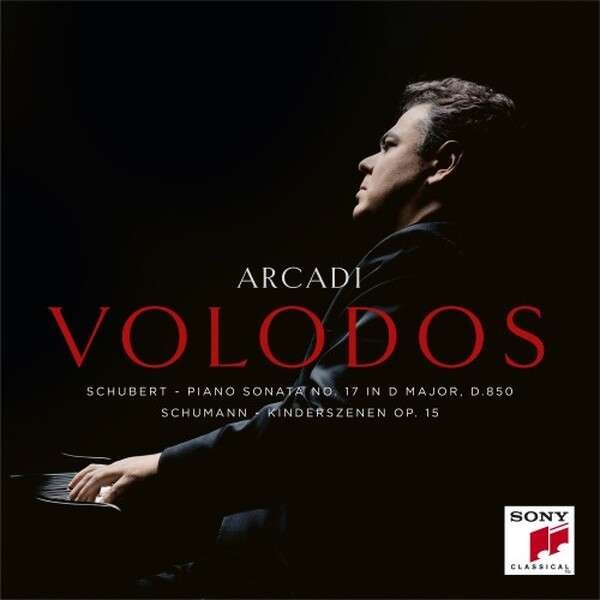
Volodos has spoken eloquently of the particular challenge Schubert presents. "The great difficulty with Schubert," he observes, "is the basic outline, the absolute transparency. The personality and spirituality of the interpreter shine through in silence", a remark that encapsulates the essence of his performance. Following his earlier accounts of the great G major Sonata D 894 and the A major D 959, he now addresses the D major D 850, the so-called 'Gastein' Sonata, written during Schubert's restorative summer of 1825 at Bad Gastein in the mountains south of Salzburg.
What a beguiling player Volodos is. His touch and his sensitivity to the smallest gradations of colour transform this disc into something of a meditation on the piano itself. Technical brilliance is everywhere apparent, yet never paraded; the light and shade are exquisitely judged. His interpretation of the D 850 is masterfully crafted, showcasing the revealed textures and the prominent maturity of the playing. The fingerwork has a featherweight grace, the virtuosity worn lightly. The third movement, Scherzo, rhythmically alert and dynamically generous, is captured in a particularly fine interpretation, leading on to the deceptive simplicity of the concluding Rondo, which after so much glittering filigree closes in the most delectable hush. This is Schubert, communicated with warmth and conviction.
Volodos's freedom of approach — his preference for flexible tempos over metronomic regulation — is entirely in keeping with the composer. "It is absurd to want to fix the tempo by means of a metronome," he argues. "Music is a language, not an equation." It is the incomparable transitions, the melodies and the gently shifting harmonies that make Schubert so unmistakably himself, and Volodos has the patience and imagination to let them breathe.
The Kinderszene that follows is mesmerising. Schumann's thirteen miniatures, with the celebrated 'Träumerei' being the most familiar, were never written for children, and Volodos acutely understands this distinction. "I think that it is only when you grow older that you understand these pieces better and better," he says. "It is a question of rediscovering within oneself the child's sense of wonderment, this pure and sincere understanding of a world that one spends an entire lifetime trying to rediscover."
That sense of rediscovery animates every bar. Each piece is a jewel in itself, allowing the piano to radiate light and shade in all its nuances, and the cumulative effect is a summation of Volodos's life as an artist. When he lifted his hands from the keyboard at the close of Der Dichter spricht—The Poet Speaks, the spell, audibly, lasted longer than the reverberation. The music embodies poetry, providing emotional fulfilment.
The accompanying booklet takes the form of an illuminating conversation between Volodos and Olivier Bellamy under the heading "The important thing is to have a vision," in which the pianist explains his preference for live recordings, where he allows the music to live in its fullest sense. On this evidence, who could disagree?